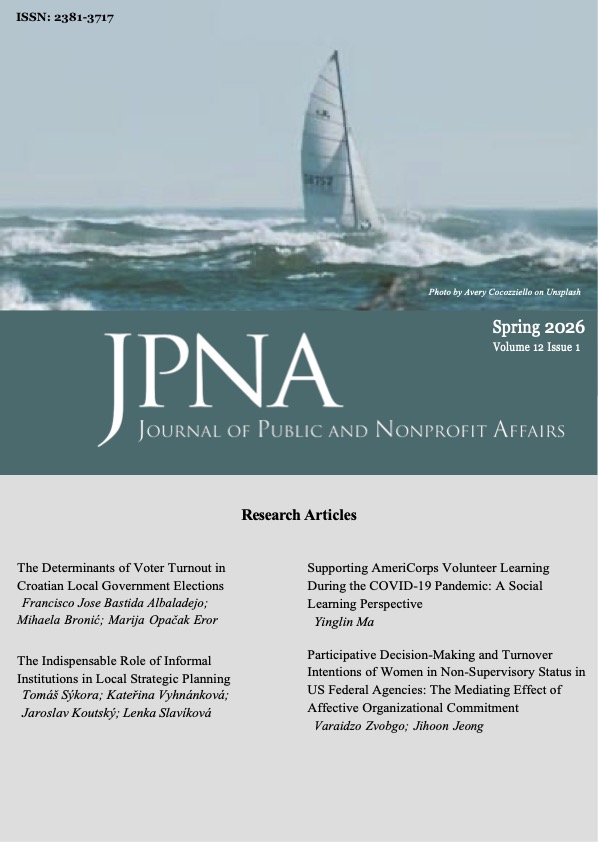
The Indispensable Role of Informal Institutions in Local Strategic Planning
DOI:
https://doi.org/10.20899/jpna.tb489p83Keywords:
Local strategic planning, Municipality development, Deficiencies in planning, Informal institutionsAbstract
Several scholars have argued that informal institutions can play a supportive and mediating role in strategic planning at the local level, particularly by shaping interactions, communication practices, and decision-making routines rather than directly enhancing the planning process itself (e.g., Rodríguez-Pose & Storper, 2006; Sotarauta & Suvinen, 2018). This study draws on qualitative methods, combining a Delphi panel with semi-structured interviews with municipal officials and experts to explore these dynamics. This article examines how planning artefacts can be strategically employed to mitigate deficiencies in the implementation and evaluation phases of municipal strategic planning in Czechia. At the same time, the study reveals several deficiencies in the current use of these artefacts themselves – particularly issues related to human agency (e.g. enthusiasm, motivation) and methodological shortcomings in strategic work (such as excessive analytism or the absence of a genuinely strategic approach). Clarifying both dimensions allows us to assess not only the potential of planning artefacts but also the conditions under which they can function effectively. Based on the expert assessments, a coincidence matrix is proposed to visualise the relationships between specific deficiencies and planning artefacts, offering a practice-oriented framework for improving local strategic planning.
Downloads
Published
Issue
Section
License
Authors who publish with this journal agree to the following terms:
- Authors retain copyright and grant the journal right of first publication with the work simultaneously licensed under a Creative Commons Attribution License that allows others to share the work with an acknowledgment of the work's authorship and initial publication in this journal.
- Authors are able to enter into separate, additional, contractual arrangements for the non-exclusive distribution of the journal's published version of the work (e.g., post it to an institutional repository or publish it in a book), with an acknowledgment of its initial publication in this journal.
- Authors are permitted and encouraged to post their work online (e.g., in institutional repositories or on their website) prior to and during the submission process, as it can lead to productive exchanges, as well as earlier and greater citation of published work (see, The Effect of Open Access).