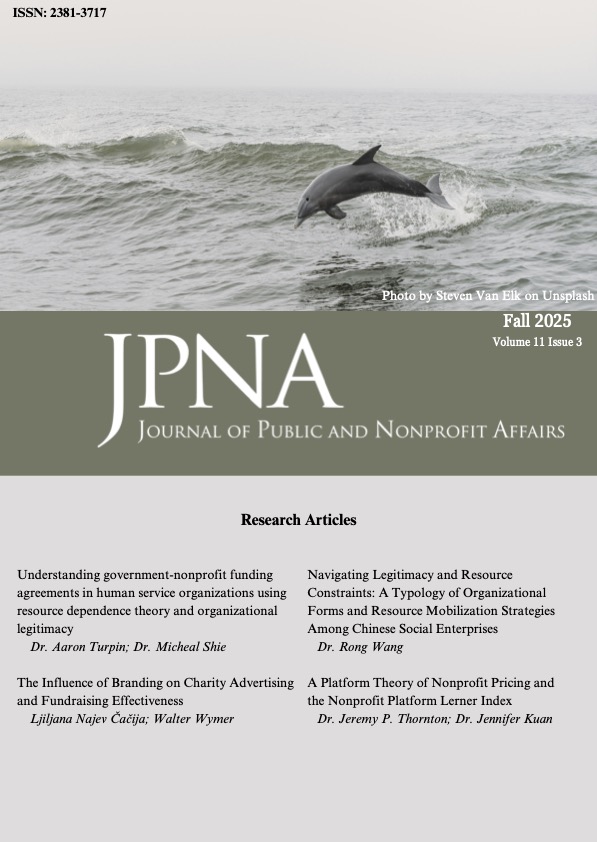
The Influence of Branding on Charity Advertising and Fundraising Effectiveness
DOI:
https://doi.org/10.20899/jpna.bw77r189Keywords:
Fundraising, Charity advertising, Brand management, Nonprofit marketingAbstract
In this paper, we describe a study designed to contribute to the stream of research on nonprofit brand-related topics. Specifically, we develop and test a conceptual model to add to our knowledge of the influences of brand familiarity, brand remarkability, and brand attitudes on audience support intentions (donation intentions, word-of-mouth intentions, and social network sharing intentions). We also examined the moderation influences of perceived donor risk, value congruence, and evoked sympathy. A sample of 266 individuals completed an online questionnaire. Data were analyzed using PLS-SEM. We found that brand familiarity’s influence on audience support intentions was fully mediated by brand attitudes and moderated by brand remarkability. We also found that brand attitudes’ influence on social network sharing intentions was moderated by perceived donor risk. Additional findings are presented. Theoretical and managerial implications are discussed.
Downloads
Published
Issue
Section
License
Authors who publish with this journal agree to the following terms:
- Authors retain copyright and grant the journal right of first publication with the work simultaneously licensed under a Creative Commons Attribution License that allows others to share the work with an acknowledgment of the work's authorship and initial publication in this journal.
- Authors are able to enter into separate, additional, contractual arrangements for the non-exclusive distribution of the journal's published version of the work (e.g., post it to an institutional repository or publish it in a book), with an acknowledgment of its initial publication in this journal.
- Authors are permitted and encouraged to post their work online (e.g., in institutional repositories or on their website) prior to and during the submission process, as it can lead to productive exchanges, as well as earlier and greater citation of published work (see, The Effect of Open Access).